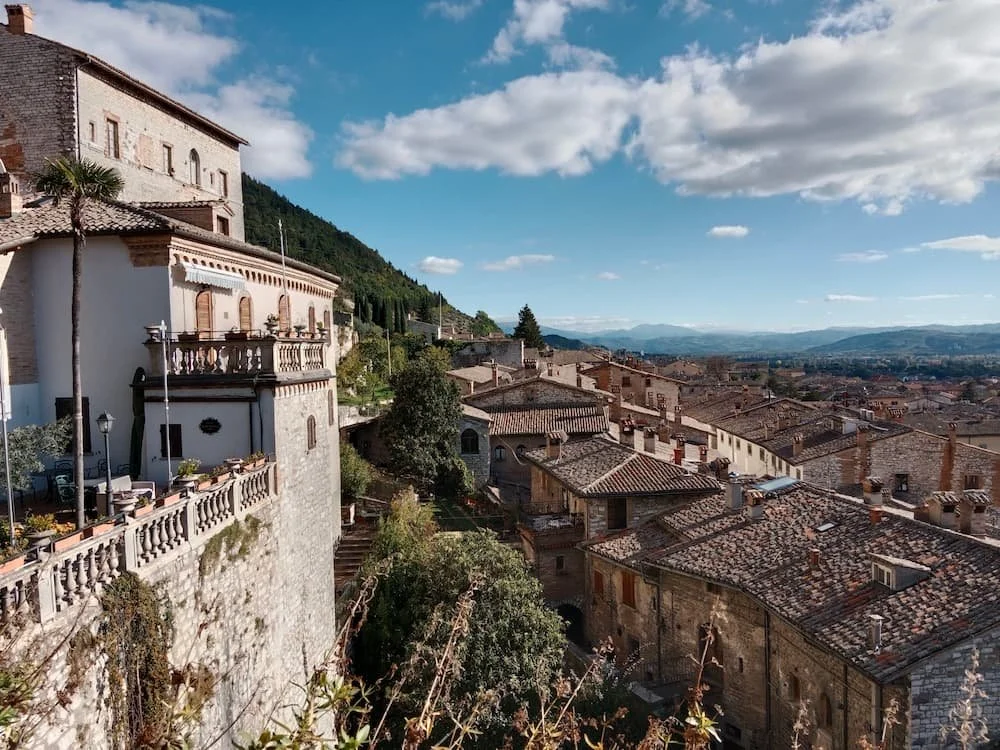
Not that I tried, but, much like Venice, I truly believe it is impossible to take a bad photograph of Gubbio — the town is a masterpiece from any and every angle.
Burning the ground, I break from the crowd
I’m on the hunt, I’m after you
I smell like I sound, I’m lost and I’m found
And I’m hungry like the wolf
Strut on a line, it’s discord and rhyme
I’m on the hunt, I’m after you
Mouth is alive, with juices like wine
And I’m hungry like the wolf
~ Hungry Like the Wolf, Duran Duran
Great Gubbio! 40 Days & nights in Italy’s Most Beautiful Medieval City
I’m drifting off to sleep when the howling of wolves somewhere in the not-too-far-off distance tugs my subconscious back into the here and now. I rub my eyes and sit up, my senses piqued. It seems to be coming from the top of the mountain I had climbed earlier that day. A sliver of its summit is visible from my bedroom window; just beyond the patchwork of tiled rooftops, stocky bell tower whose clang shakes me awake every morning, and a dense hedge of poplars that skirt its base.
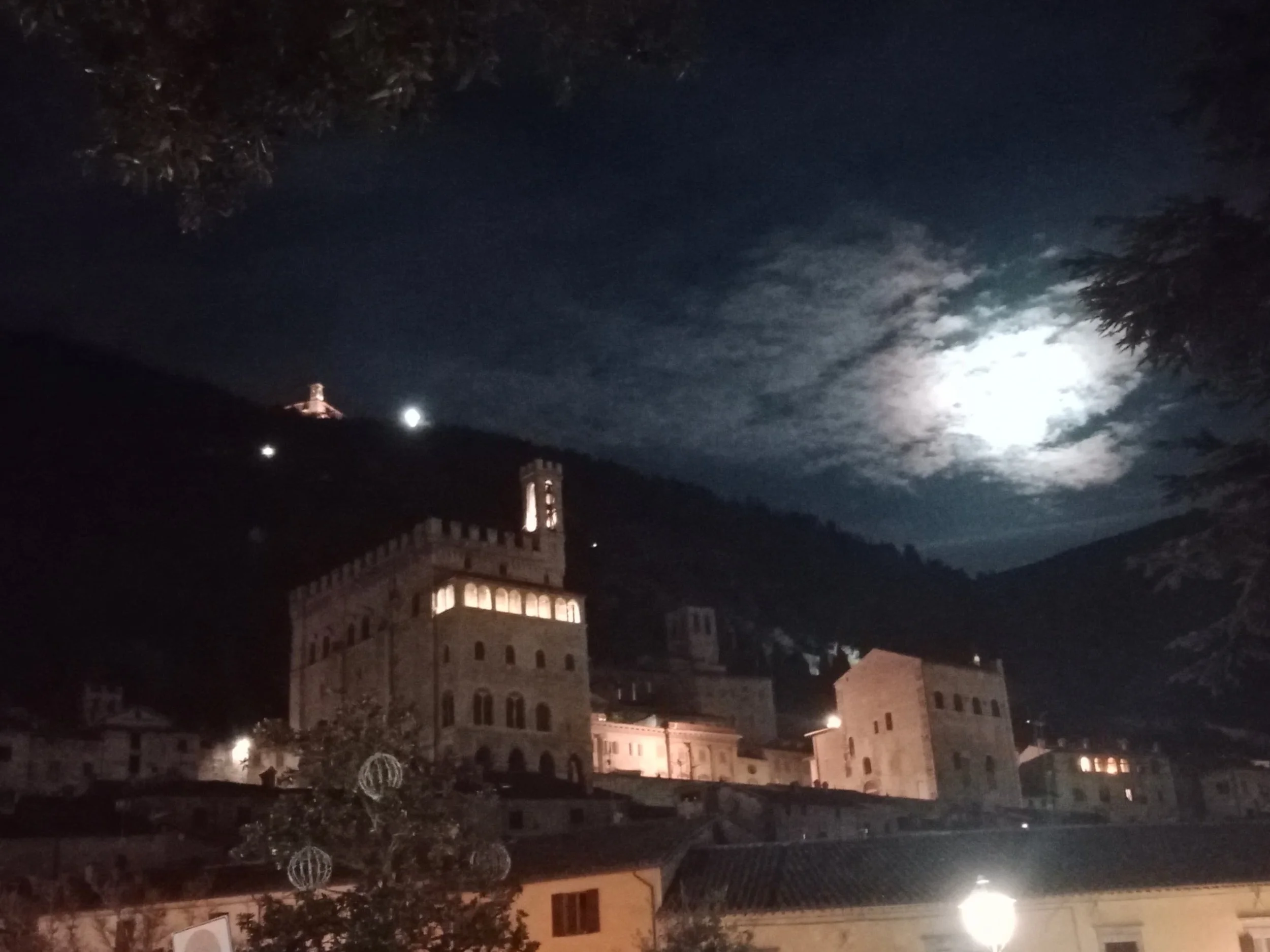
A full moon crashes through the cloud cover, illuminating Mt. Ingino as Palazzo dei Consoli lords over the town from its perch at the foothill of the mountain.
A sustained howl echoes over the medieval town, blanketed in moonlight at this late hour. Definitely not my imagination, I reassure myself. That is the unmistakable howl of a wolf. Safe and sound under the covers, I imagine a wolf pack high up on the mountain — snouts pointed towards the full moon, eyes flashing like frosted swords, paws ripping apart the moist black earth.
At this point, it dawns on me that I’d decided to spend 40 days and nights living within this ancient fortress – a number not without significance in this primarily Catholic country.
And while I had noticed more than one statue of a wolf around the historical center during my first few days, I hadn’t paid much attention to them. That is, until serendipity reared its head.
Hunting for a new book to read, I came across the bibliography of a familiar Canadian author, Michael Bedard. I scanned his list of published works, but my fingers froze over the keyboard when I came to The Wolf of Gubbio. Despite being intimately familiar with his writing (one of his daughters and I attended the same University), I had missed this title entirely.
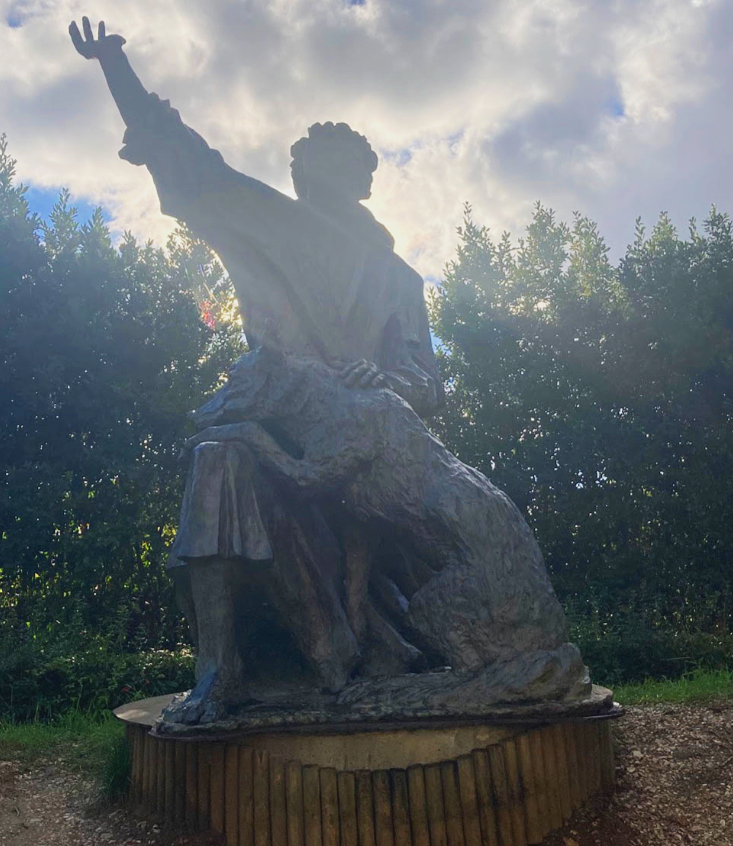
A statue honoring St. Francis of Assisi with the Wolf of Gubbio sits at the entrance to the ancient walled city.
Thanks to Bedard's novel, I soon discovered the inspiration behind The Wolf of Gubbio lay in one of many wondrous legends about the much-beloved St. Francis of Assisi.
It chronicles the story of a predatory wolf who, as legend has it, terrorized the townspeople of Gubbio in the early 13th century — first by attacking livestock and, not long afterward, their human counterparts. As the story goes, the attacks grew so savage that, at some point, no one dared venture outside the city’s fortified walls. That is, until one day the gentle St. Francis, well known for his love of animals, arrived in town, befriended the beast, and commanded it to cease the attacks in the name of God. And that the wolf did.
In return for the wolf halting his siege on the town, St. Francis promised the townspeople would care for him. And with that, so it was.
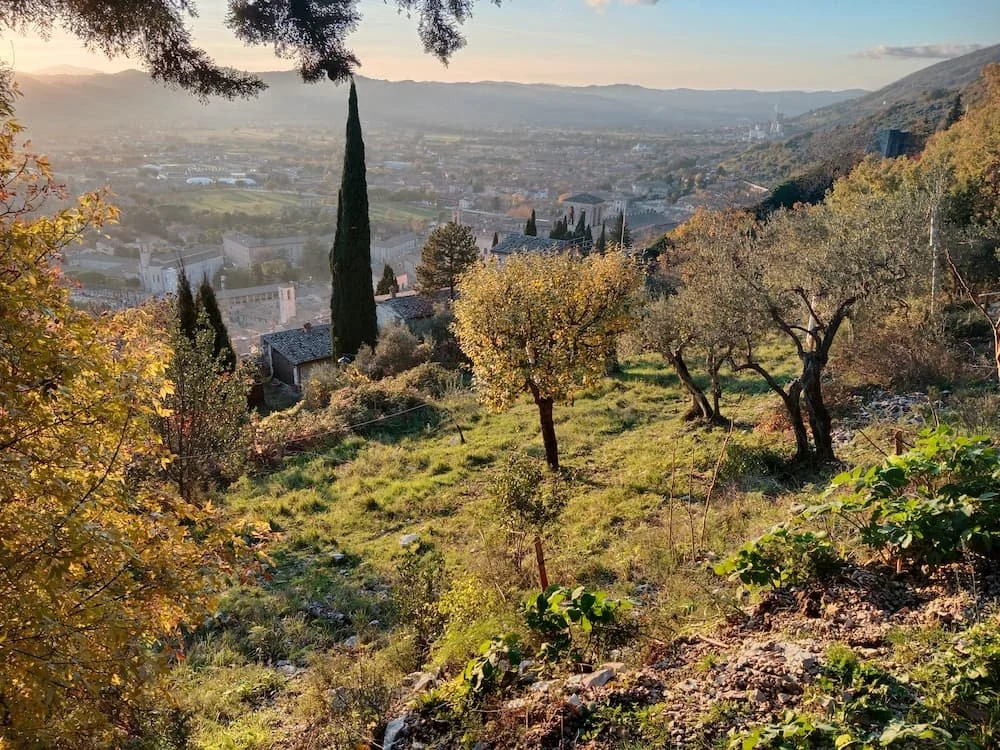
Autumn in Gubbio brings with it a blaze of colors best admired from the hiking trail that snakes its way up to the summit of Mt. Ingino.
But this great tale does not end here. It’s said that when the wolf died, the Church of Saint Francis of the Peace was built upon the beast’s final resting place. Centuries later, during renovations in 1872, a large wolf’s skull was discovered beneath the stones. Fact, fable, myth, legend, or miracle? I suppose it depends on what (some might say if) you believe.
As for the wolves (wolf?) and me, I repeatedly heard during my time in la più bella città medievale; I never bothered to ask any of the locals I met if they too heard the howling at night. I didn’t want to know. Scratch that: I didn’t need to know.
As I spent many an evening staring up the cliff at the hillside, a blaze of tangerine lighting up the sky as the horizon drank in the sun in big gulps, I felt a connection to this beautiful story. Fact, fable, myth, legend, or miracle? It didn’t matter. And it didn’t change the fact that yet again, I would climb into bed and, tucked safely under the covers, await the howling of the wolves.
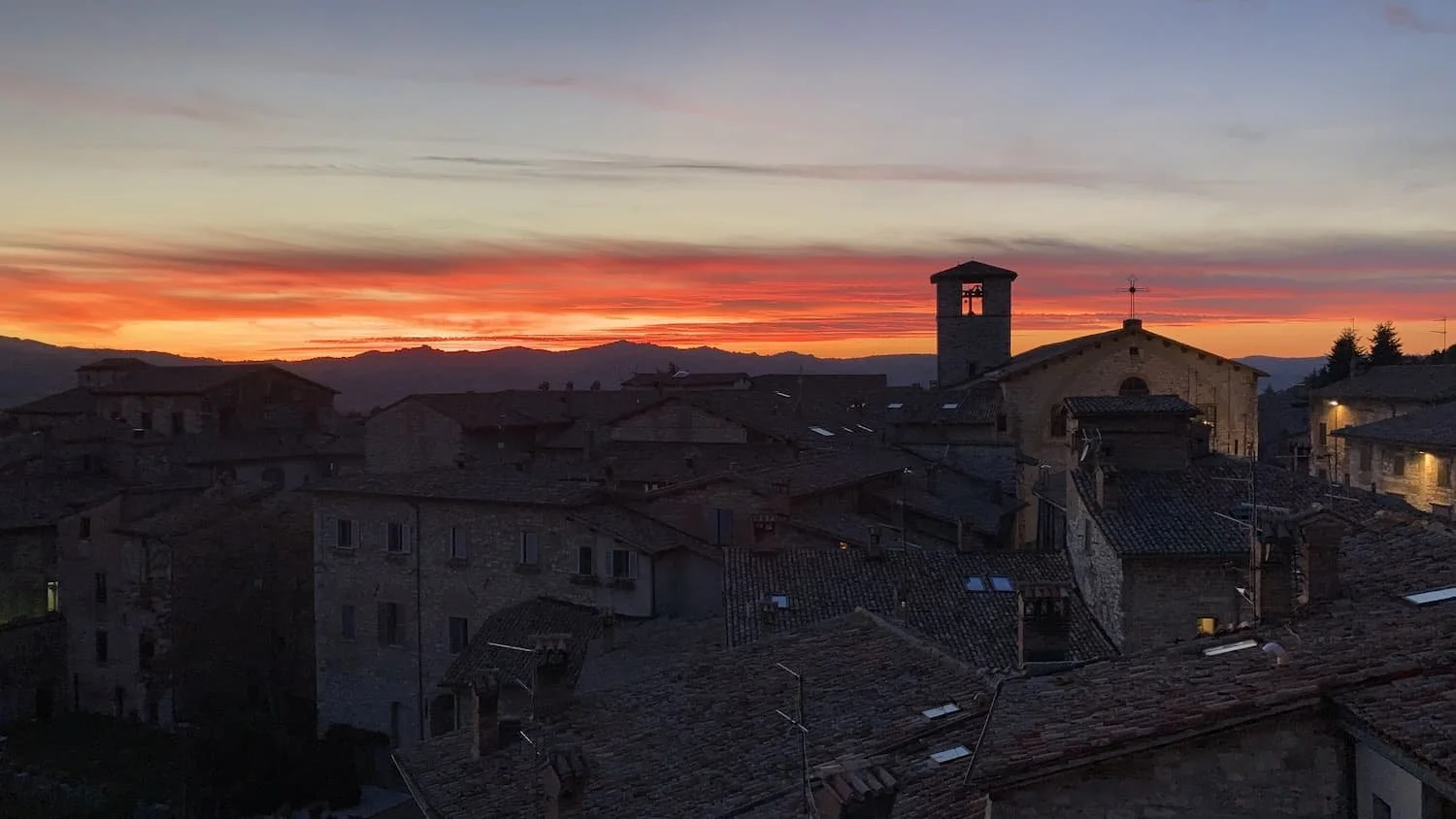
Sunsets in Gubbio are watermarked with fiery strips of tangerine and 80s neon pink.
Sunset in Gubbio, Italy from the bedroom window of my flat.
No AI was used in writing any part of this blog. All material is the author’s sole intellectual property.