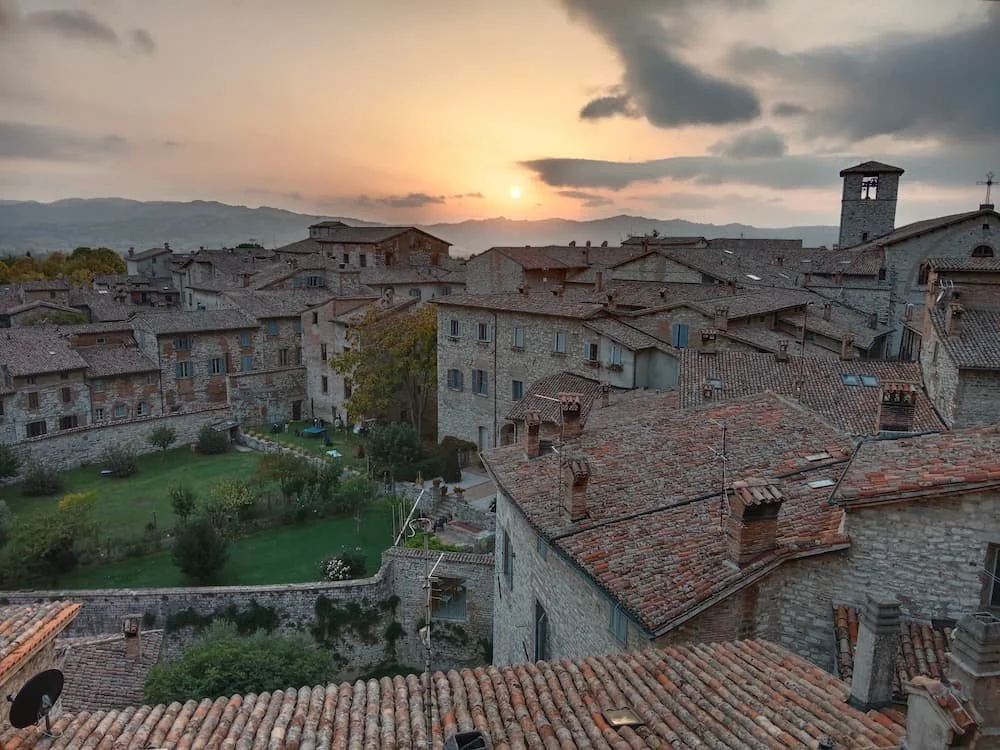
For forty nights, I drank in this magnificent view of Gubbio’s historical center from my flat (and was shaken awake each morning by a Holy Trinity of church bells).
Gold, I swam into your spell
On the rite of God we fell
You were plush and I laid bare
You had me howling.
~ Howling, RY X
40 Days in Gubbio the Great (Italy’s Most Beautiful Medieval City)
With the legend of the Wolf of Gubbio behind us, it’s time to get to the meat and potatoes (literally) of la più bella città medievale.
Approximately 50 km north of Assisi, this ancient landlocked town of around 30,000 sits smack dab in the beating heart of Umbria — a region known as the green heart of Italy (save the surprisingly bad air in wintertime, but more on that in another post). As Silvia, my charming Airbnb owner, confessed, Gubbio is quietly building a reputation as an alternative to Tuscany, its more famous (and far more expensive) cousin. It’s also unlike anywhere I have ever been.
At times Gubbio reminded me of a beautiful Swiss mountain town—not least of all because it is so clean and well-cared-for (out for a walk one day, I happened upon two women sweeping up some olives that had fallen onto the road. As in, the kind you drive on); other times it felt more like Prague or Tallinn’s charming Old Town. But then the fall rains came, filling dry riverbeds that score the historical center with gushing currents of water, and suddenly I was transported to Venice.
Day to day, I never knew which Gubbio would greet me when I left my flat. But given my penchant for spontaneity, I’m happy to report that we all got along just fine.
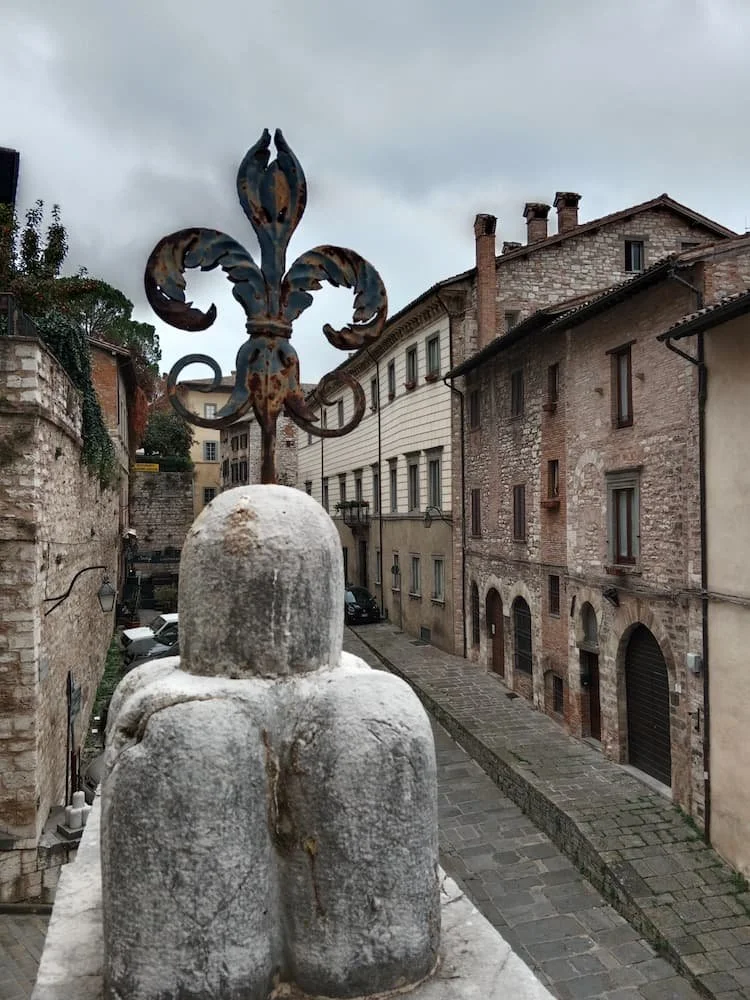
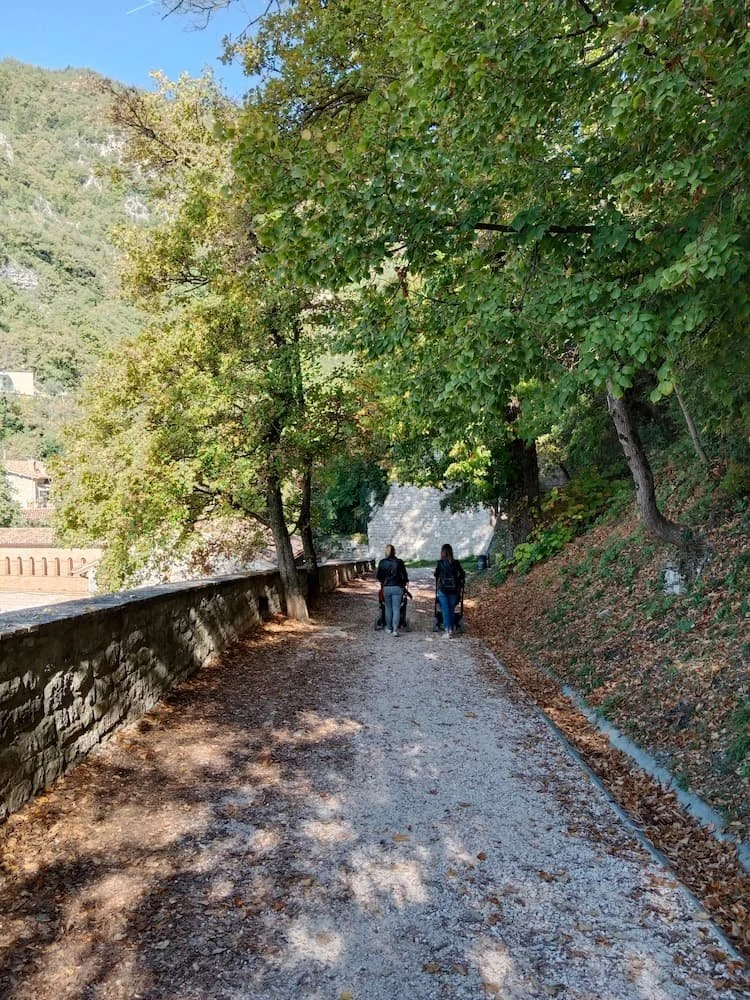
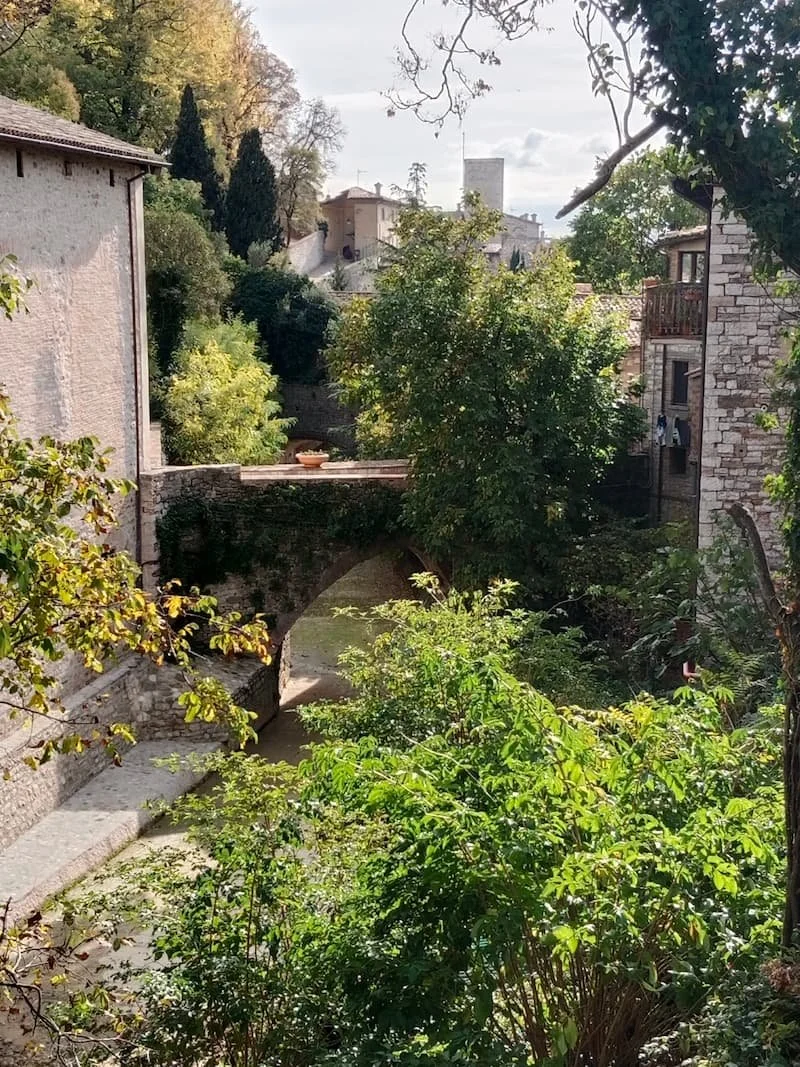
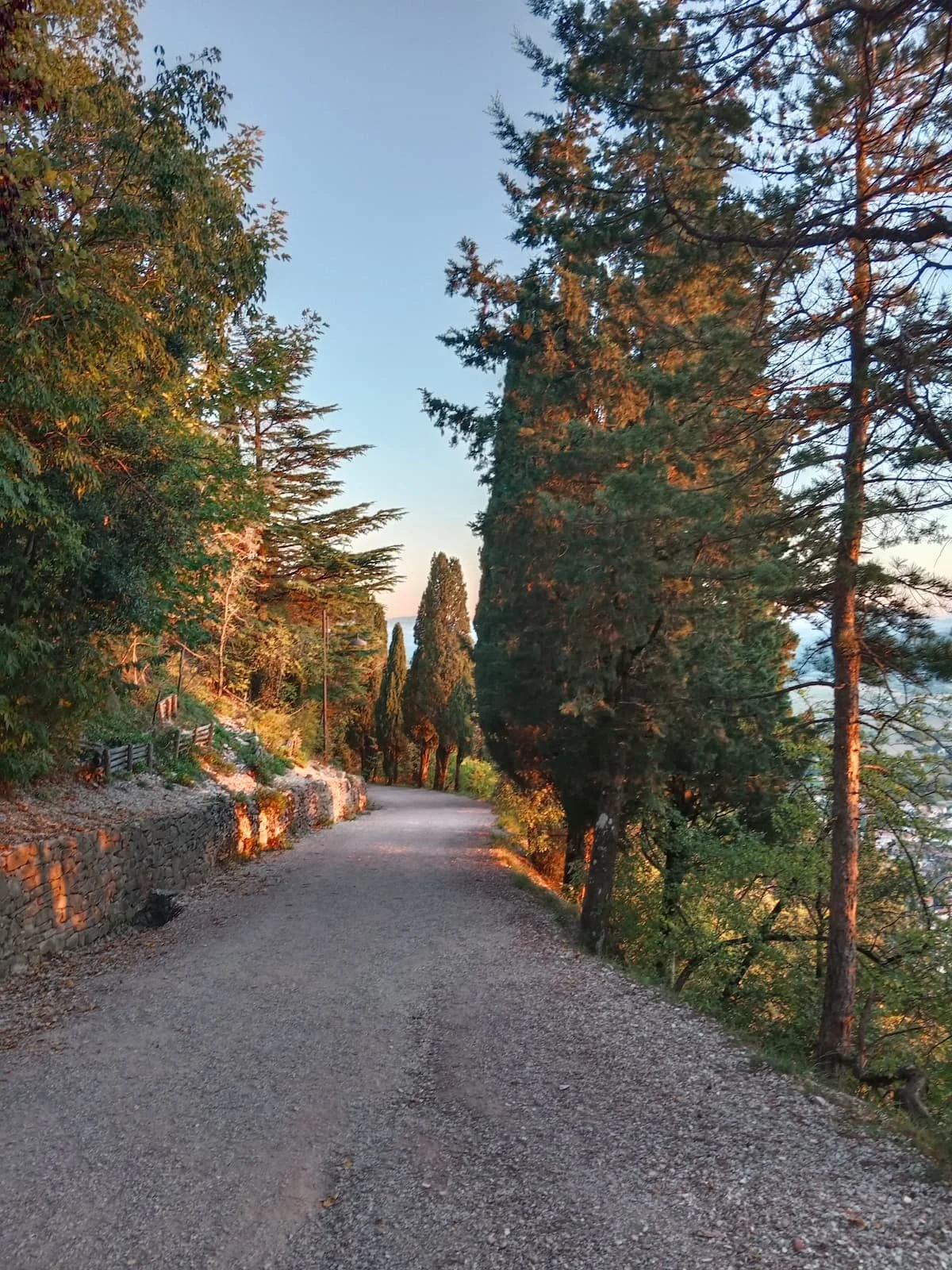
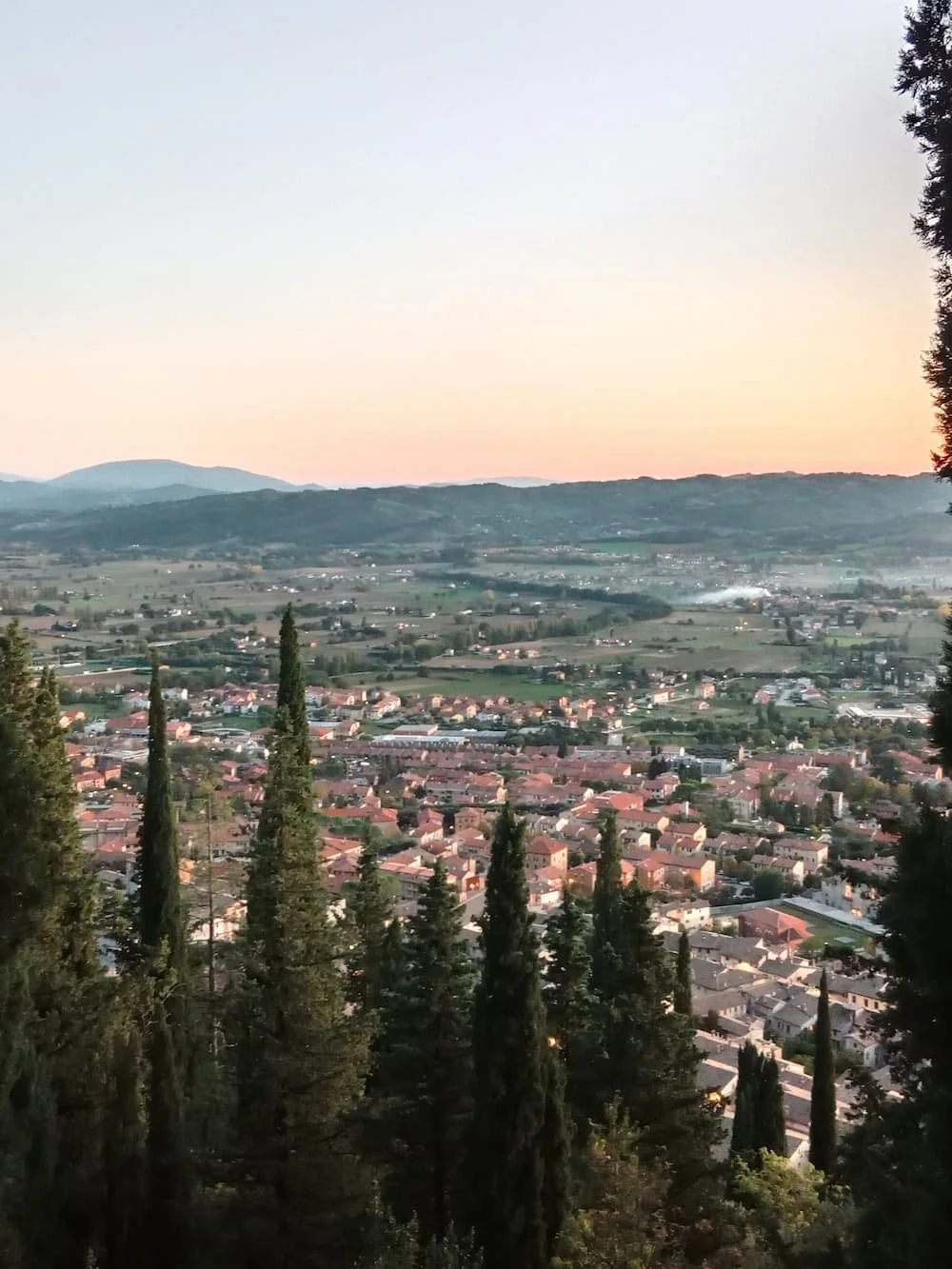
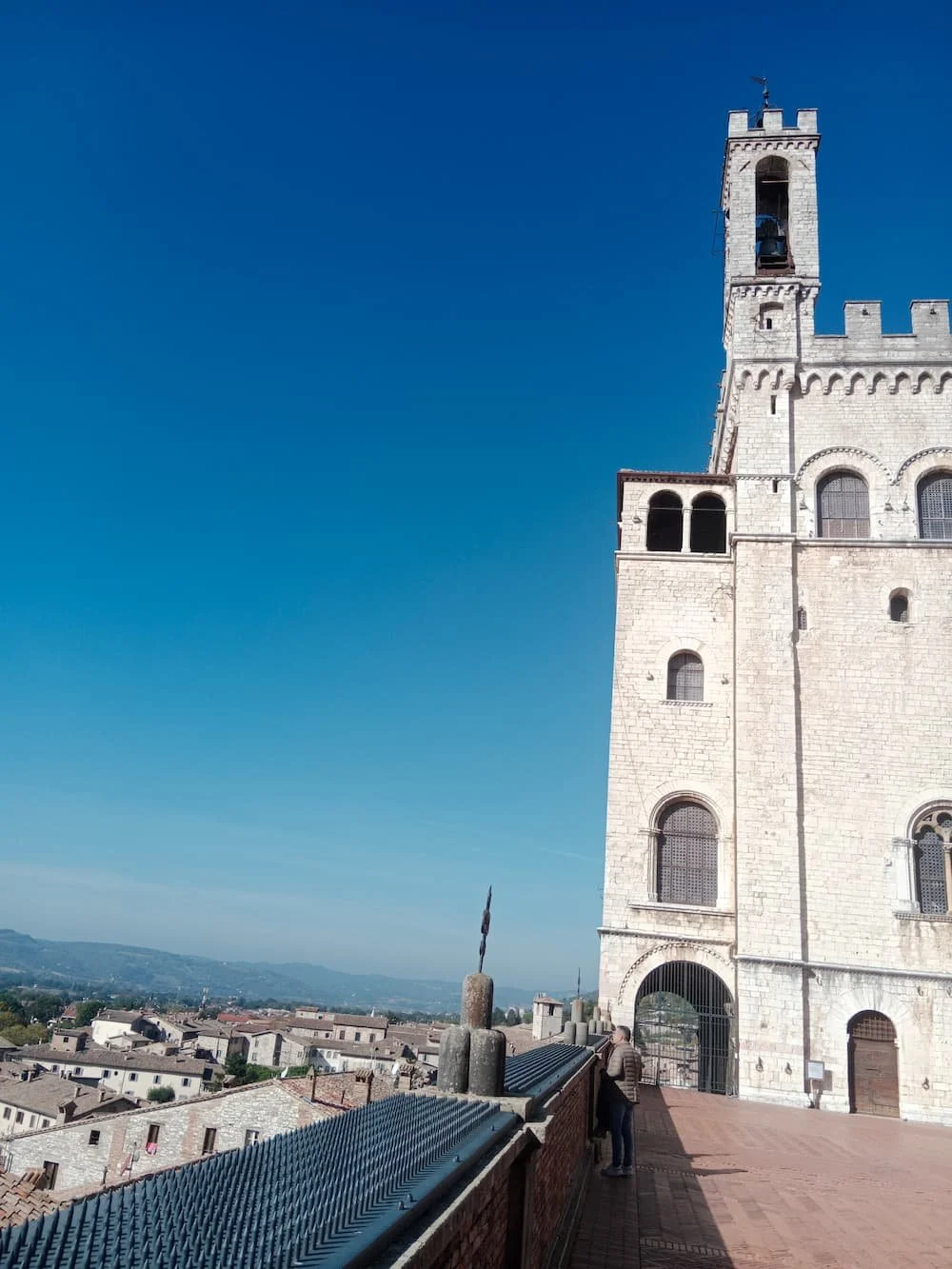
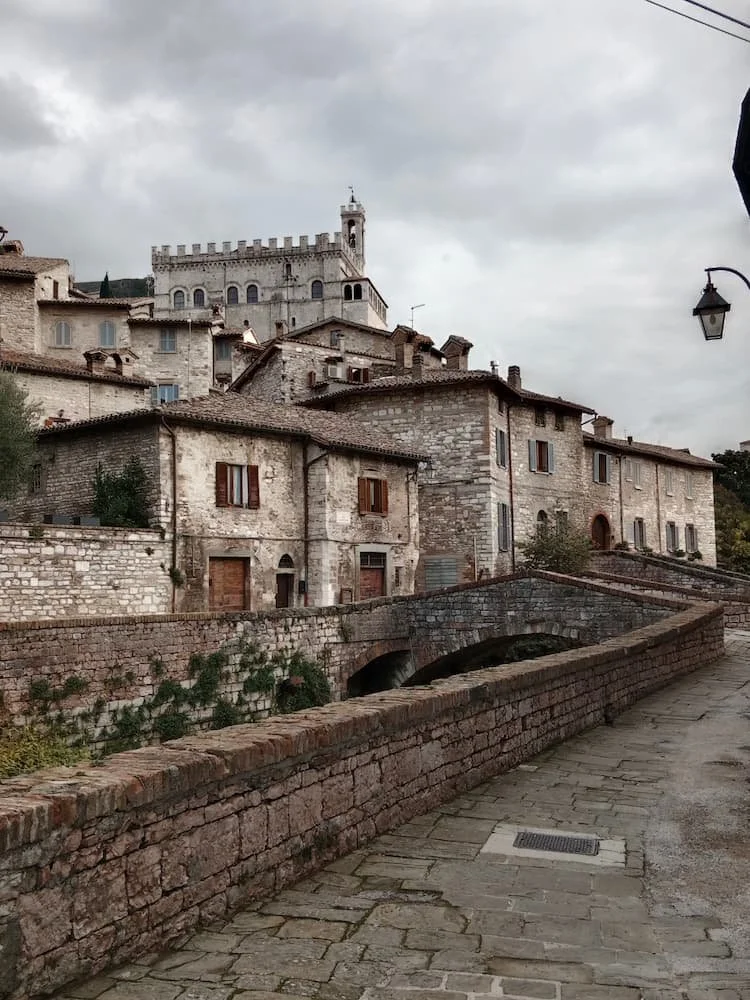
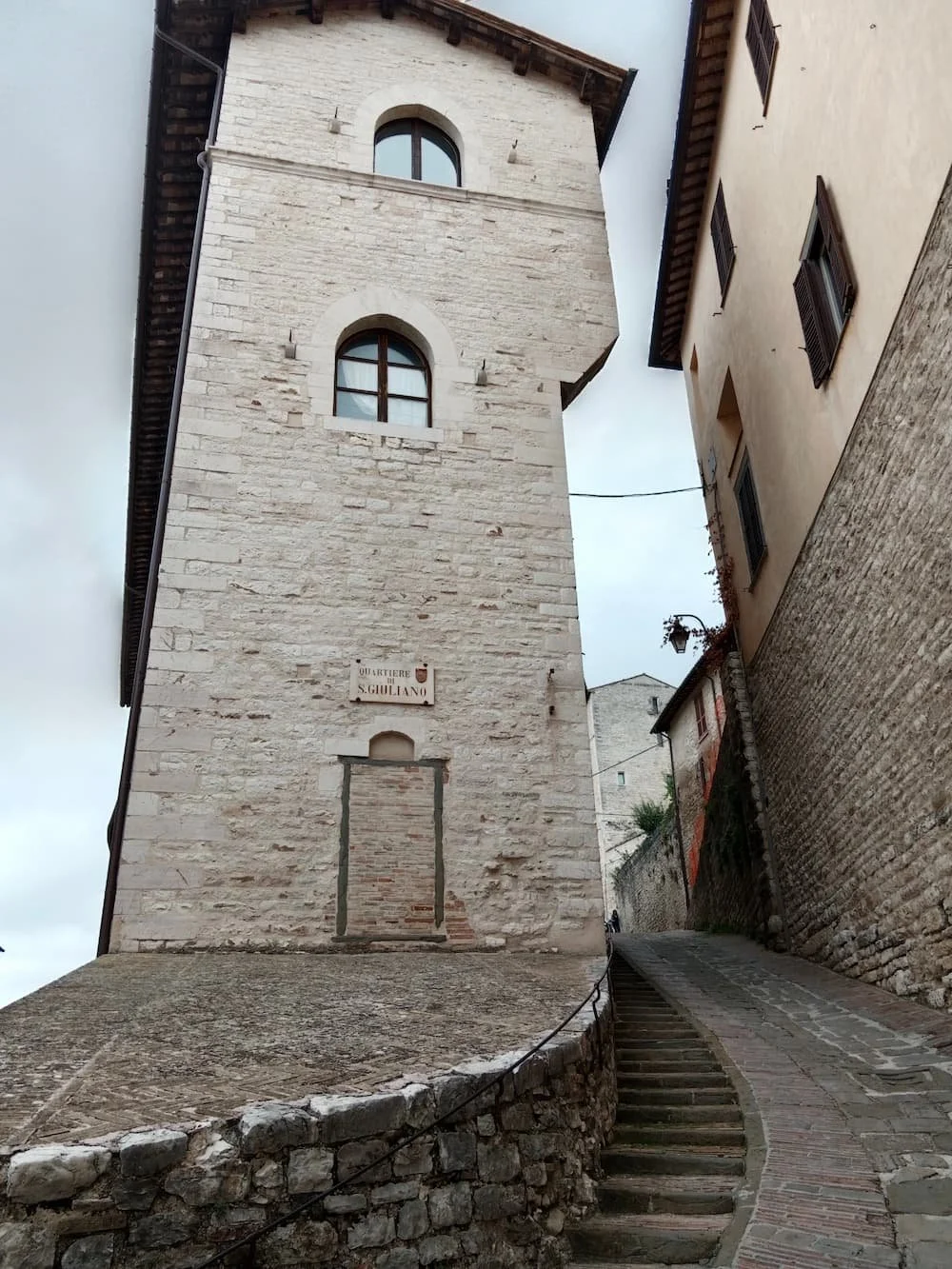
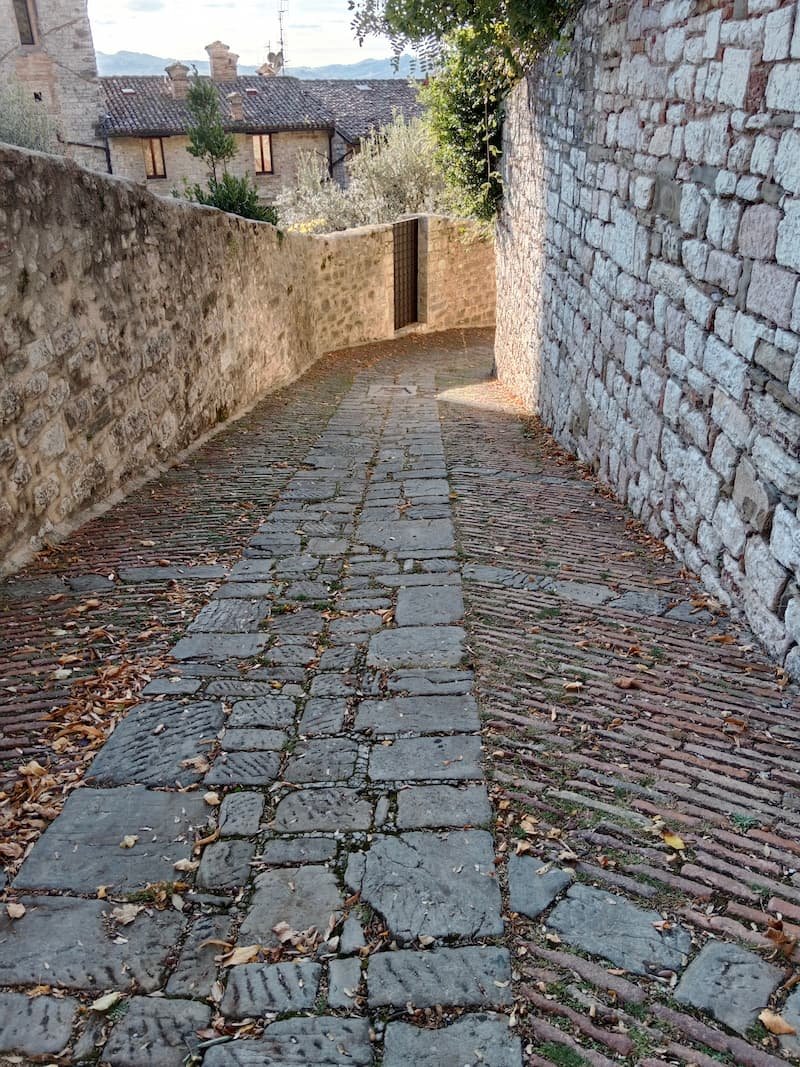
Despite not getting as much press as her more famous neighbors, Gubbio has ancient roots that go all the way back to the Bronze Age. But it really began to grow into a power in its own right during the First Crusade (1096-1099) when the town sent an astonishing 1000 of its knights to fight in the “Holy War.”
In the decades (and centuries) that followed, Gubbio, like many cities and townships throughout the region, did not always get along well with its neighbors. Luckily, these tumultuous years were punctuated by a time of great prosperity thanks to a medieval bishop named Ubald of Gubbio (today celebrated as Saint Ubaldo).
This particular chapter of its history began in 1151 when, after a number of neighboring towns allied against Gubbio, Ubaldo took over as commander of the forces, ultimately leading them to an astonishing victory. The result was not just a time of prosperity for Gubbio but a loyal populace who came to see their bishop as their protector (quite possibly with extraordinary powers).
Still today, people pay their respects by climbing Mount Ingino to the Basilica named after Ubaldo, now the patron saint of Gubbio, whose body remains encased in glass and displayed upon the church’s main altar.
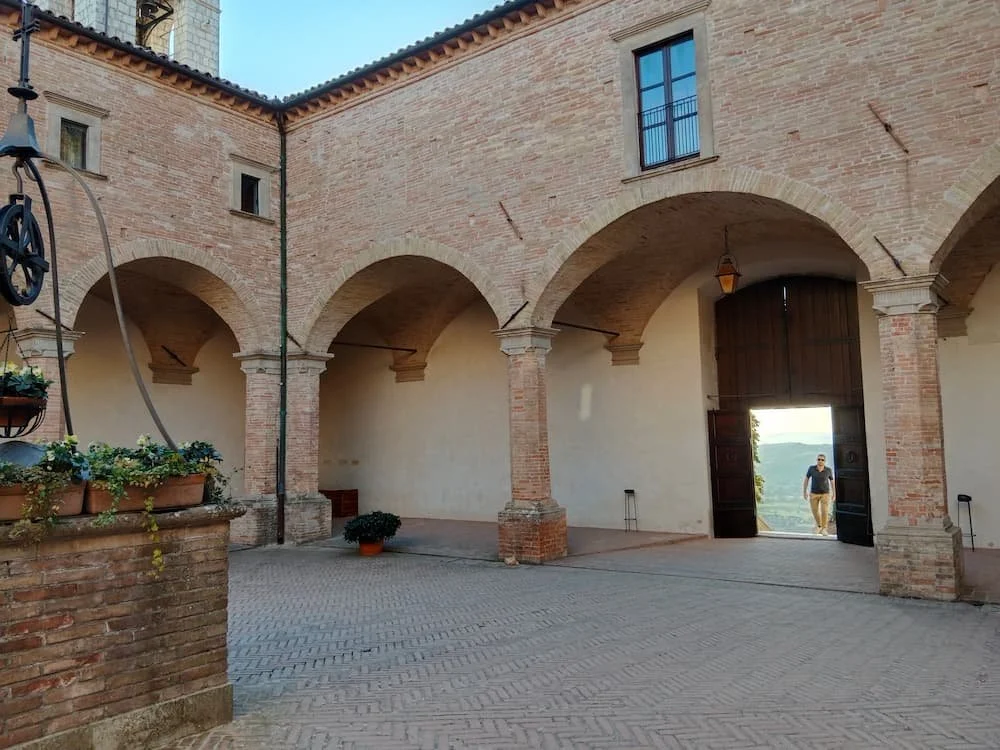
Inside the courtyard of the Basilica di S. Ubaldo.
Whether or not the sight of Saint Ubaldo is for you, the church is most certainly worth a visit, as is the summit—a place from which you will enjoy staggering views of Gubbio and the surrounding Apennine mountains (an area that also happens to be one of the last refuges of the Italian wolf…hmm).
And that, dear reader, brings us to the business of getting up the mountain. A journey that presents you with two choices:
Hike
Take the funicular
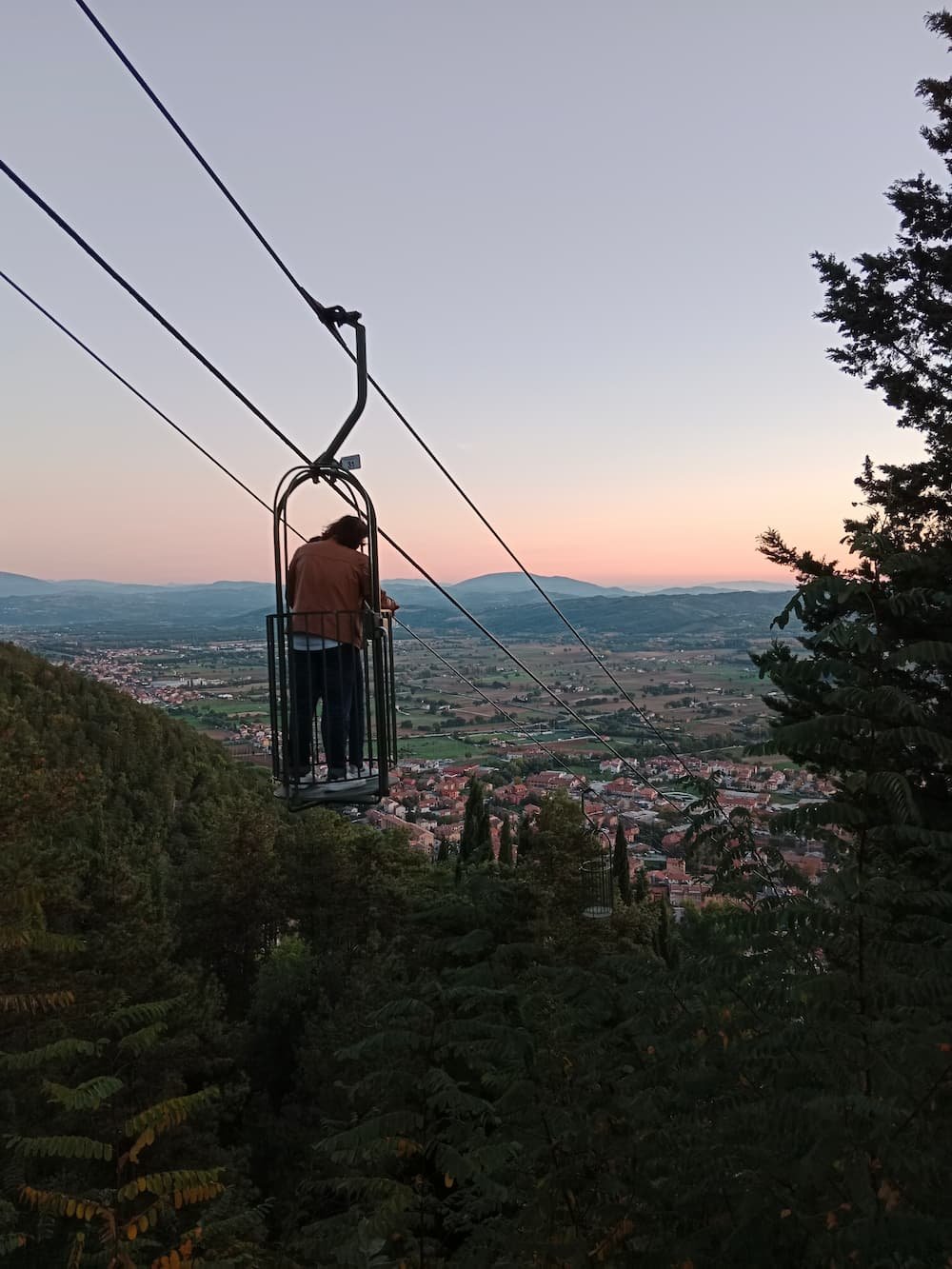
This seems like the point at which I should disclose my crippling fear of heights. The kind of fear that barely allows me to climb a ladder to change a lightbulb. And yet, I wanted to write this blog. The consequence? I knew I would have to hang suspended in a metal death cage, teeth chattering, bladder quivering, as it inched towards its destination in the sky. Did I mention I’m scared of heights? I only have to take it up the mountain, I reasoned. I can hike back down on my own two blissfully earthbound feet. Should I be overcome by an urge to clutch onto something for dear life, my travel companion will be there with me. Just do it.
So we did. For the record: I was none too happy about it, either.
The good news is that if you’re staying anywhere in Gubbio’s historical center, it’s not hard to find the funicular. The bad news is that if you’re staying anywhere in Gubbio’s historical center, it’s not hard to find the funicular. There are quite a few signs sprinkled here and there to point you in the direction of certain death, lest you lose your way.
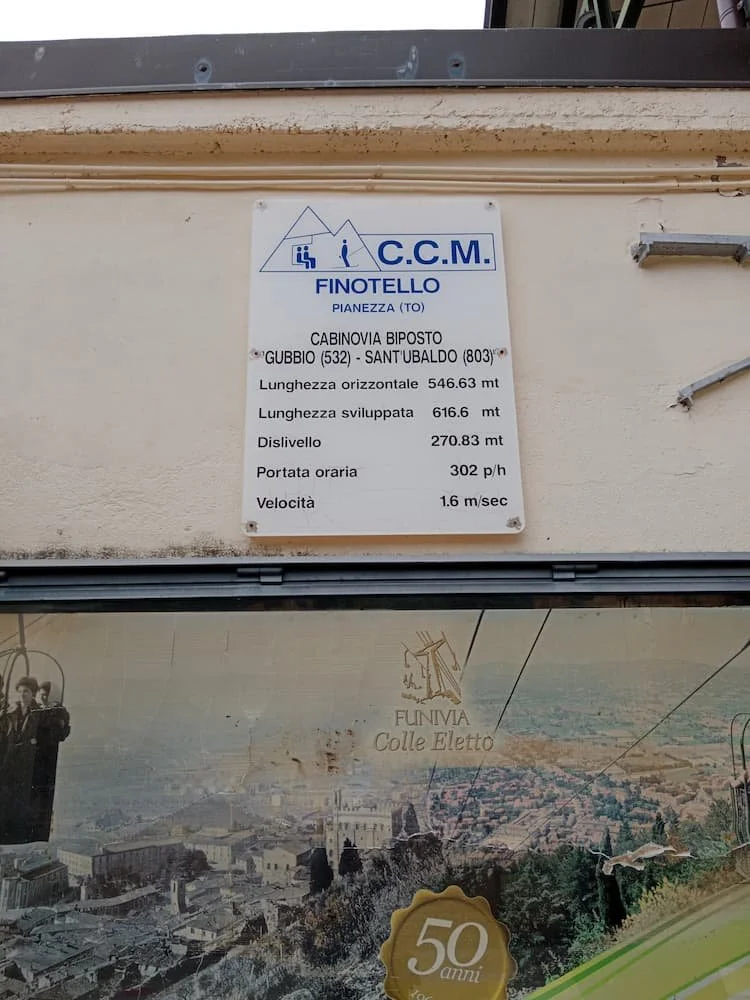
Some important numbers about the funicular for those who like facts.
There is a grand story about the man whose dream it was to build the funicular, which I have since forgotten. I do remember it involved wanting to provide an alternate route to the Basilica so those who wanted to visit Saint Ubaldo could do so without exerting themselves climbing a small mountain. Clearly, this man had never met anyone scared of heights.
And so, while traveling at a velocity of 1.6 meters per second is not exactly breaking the sound barrier, it was enough to work up a thirst for an afternoon spritz, which we enjoyed from a beautiful little café/restaurant after visiting the Basilica. This vantage point gives you a new appreciation for Gubbio’s beauty, and for its structure.
From here, the 3km of walls surrounding the town are clearly visible—as is the city’s design, which breaks up the historical center into a kind of Medieval Where’s Waldo. The Old Town buildings, all preserved from the 12th century or thereabouts, according to locals, give you a sense of just how much stone weighs down this tiny city. It is a striking sight, and one that I happily climbed the mountain to enjoy several times over my 40-day stay.
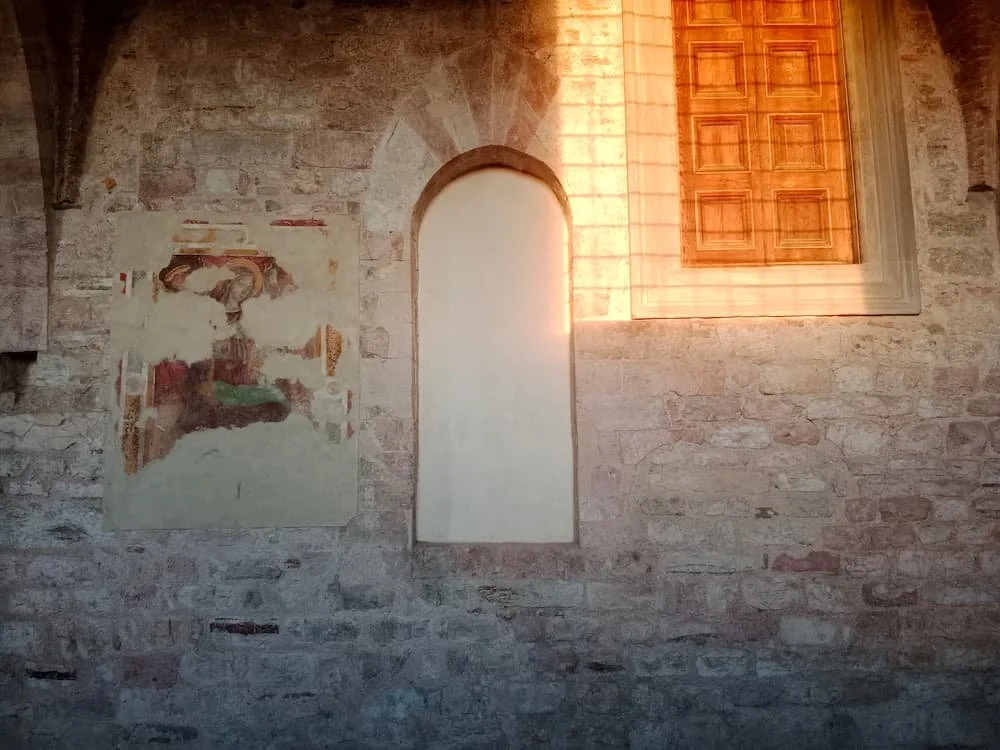
A lambent afternoon light illuminates the covered passageway outside the entrance to the Palazzo Ducale where the fractured fresco of the Madonna del Latte can be admired.
Fun fact: The water for the original roof garden (Ducal Gardens) was made possible thanks to an ingenious engineering design that included large tanks to collect water for irrigation and powering a large fountain. The fractured fresco of the Madonna del Latte (pictured above) sits just below the point where the pipeline once brought water from the tank to the garden, hence its name.
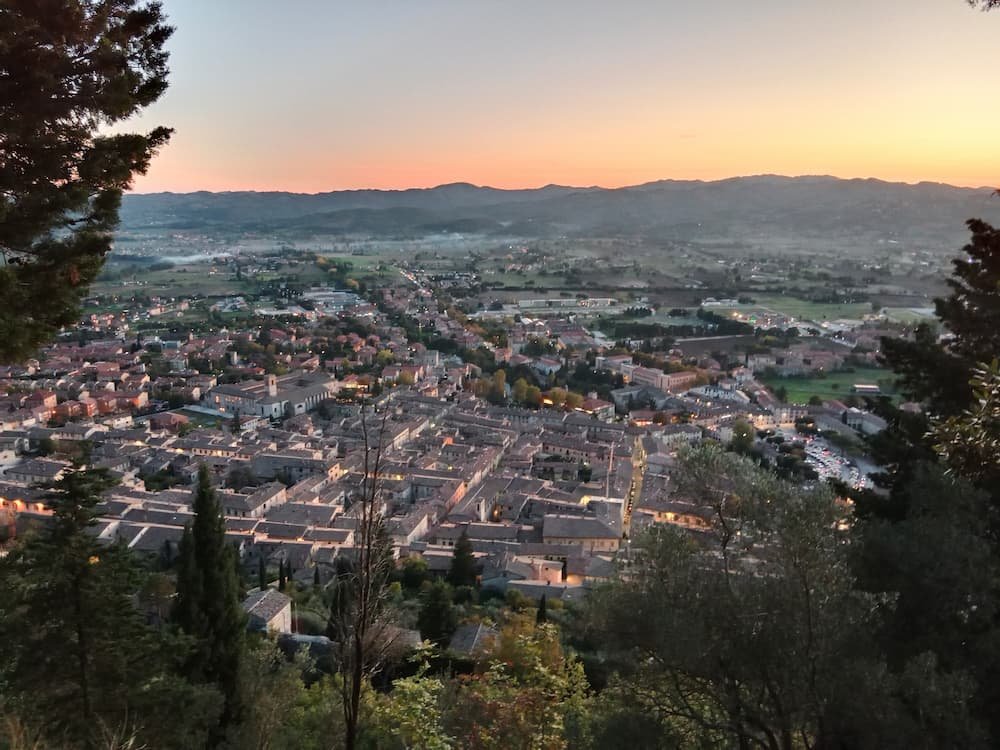
Gubbio — A medieval Where’s Waldo if ever there was one.
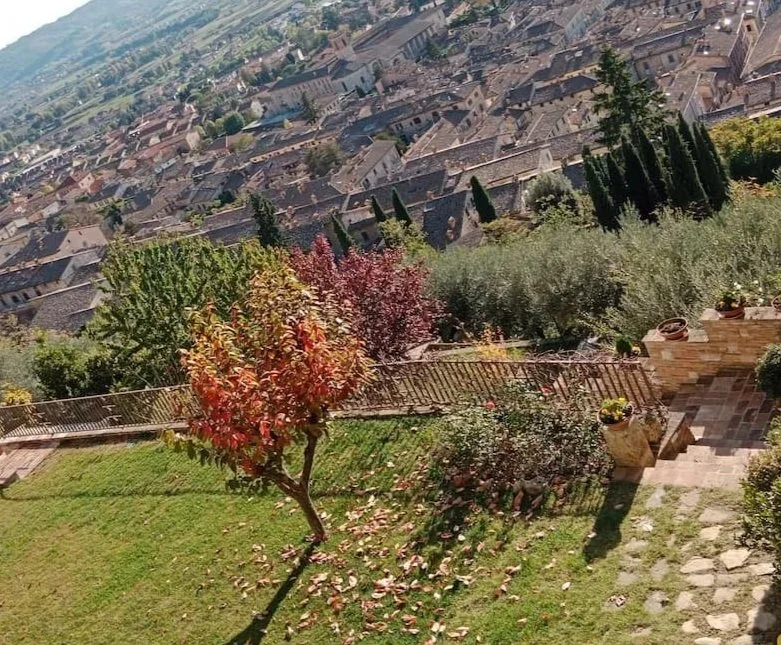
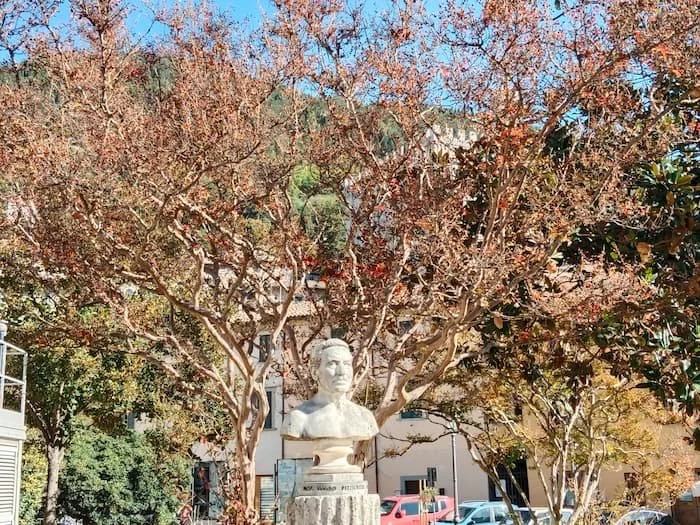
Leaves the color of fiery crimson, pomegranate, and drunken pears light up the ground in autumn.
If you plan the day right, after visiting the Basilica you can hike back down just before sunset, stopping along the way to take in the Palazzo Ducale (including its achingly beautiful rooftop garden) before the sunset bursts forth onto the scene at the Palazzo dei Consoli—a structure that by all definitions behaves as Gubbio’s main square and is known as Piazza Grande. Erected in 1349 after approximately 8 years of construction, this Gothic building is as impressive as it is menacing. Lording over the town, the eye seems to be drawn to it by force, particularly at nighttime when the moon behind it makes for a dramatic backdrop.
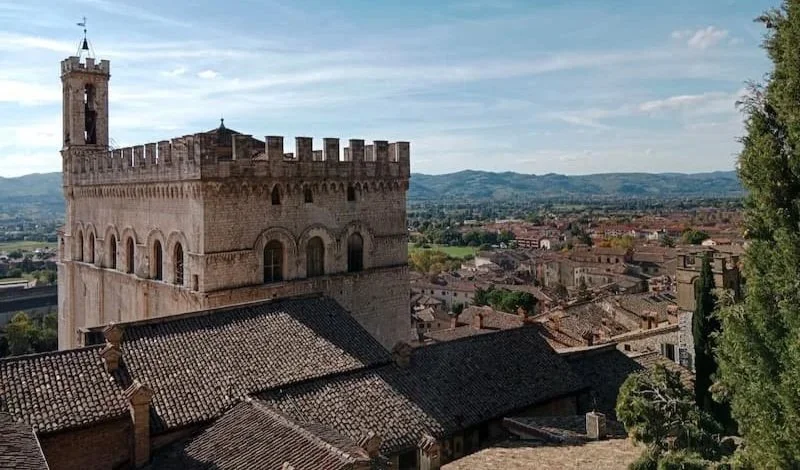
Palazzo dei Consoli stands guard at the foothills of Mt. Ingino like a dedicated foot soldier.
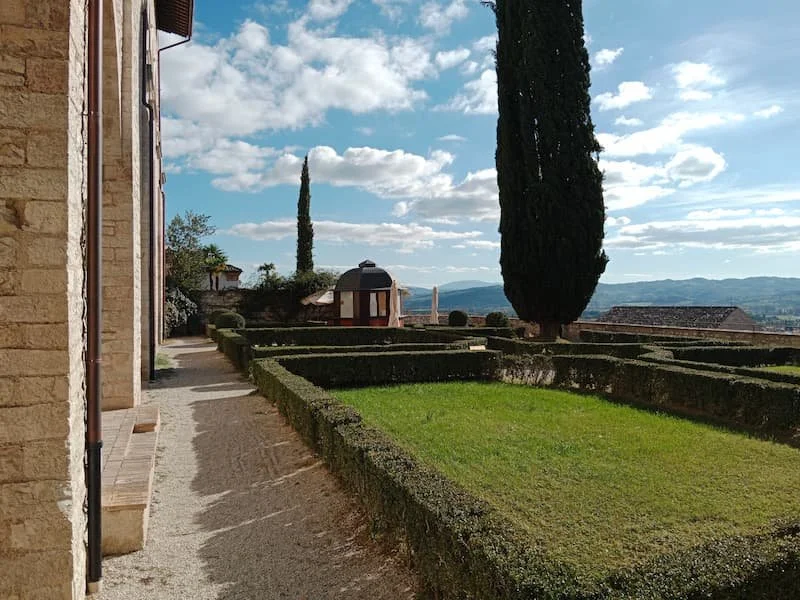
The well-manicured gardens of the Palazzo Ducale (Ducal Gardens) are a shock of green (literally) in the midst of this city of stone.
Across from Palazzo dei Consoli is an impressive Neoclassical brick palazzo (the Ranghiasci-Brancaleoni). Now a posh hotel, it morphs into a meeting place every afternoon where well-heeled tourists and locals alike (both of whom tend to be almost exclusively Italian) wade through their obligatory daily spritz (or two) before heading off to while away the evening
Should you ever happen to find yourself in Gubbio, I highly recommend this itinerary. Traveling up Mt. Ingino by funicular is a great way to save time; on the way back, you can take in some of the most beautiful and charming spots the city offers. Likewise, I suppose it would be quite beautiful in reverse—climbing up, taking in the sights along the way, and taking the funicular back down.
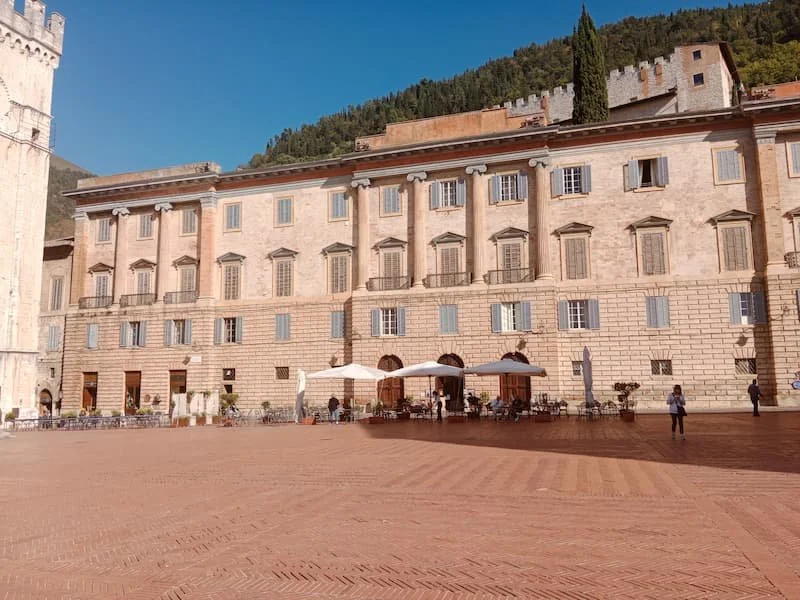
It’s not called the Piazza Grande for nothing.
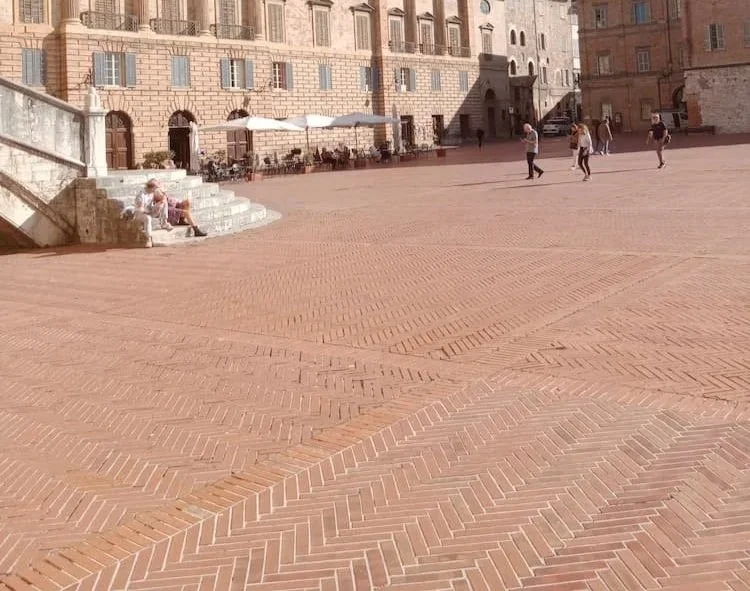
A couple takes a respite from the afternoon heat on the steps leading up to the Palazzo dei Consoli.
And now the time has finally come to tuck into your favorite restaurant for a categorically flavorful meal. Why? Because in Gubbio, truffles burst forth from the ground like dandelions. (Perhaps there’s a reason for the close proximity of all those hiking trails after all? Like working off the trough of cheese, bread, porchetta and truffles you’re about to eat.)
Luckily, not only did the best restaurant in town sit a mere 5 meters from our front doorstep, but we happened to snag a table during the Truffle Festival–a time when competition for every table, bar seat, and outdoor chair in Gubbio is at its absolute apex.
The Truffle Festival in Gubbio runs October 29th-November 1st, while the “Month of the Truffle” runs from November 1st to December 10th throughout the region. Just one more glaring sign that Italians have their priorities straight. Food festivals (known as sagre in Italian) are hugely popular with locals and a great way to get acquainted with various ingredients and taste local specialties directly from producers.
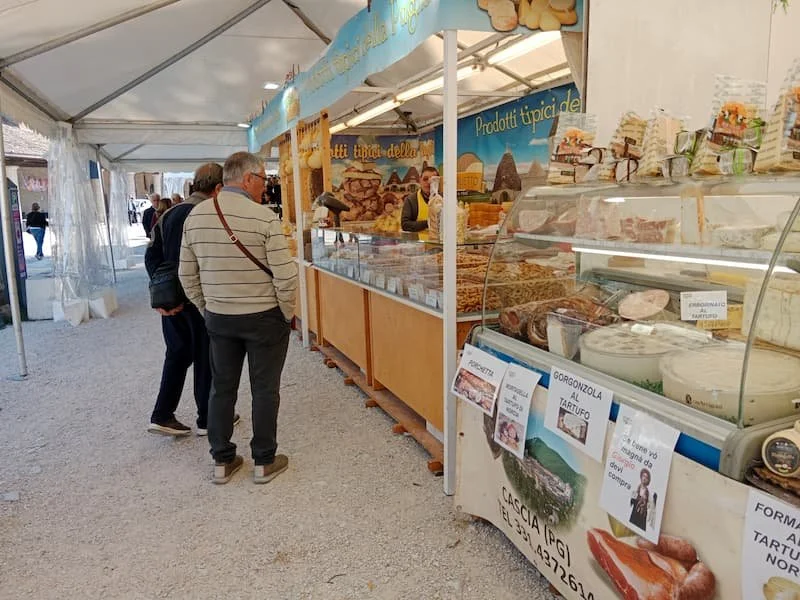
Locals mull over what goodies to buy during the Truffle Festival in Gubbio.
Truth be told, we had no idea the festival was taking place. We arrived just days before it began and stumbled across it on our way for coffee one Saturday morning. Stalls had been set up all around the lawn where the regular Saturday market normally sets up and the smell of truffles permeated the air. Once we realized what was going on, a quick jaunt to the ATM became a serious exercise in self-control. My travel companion even lost their hold on reality when they turned to me and asked, “Can we really justify spending this much money on cheese?”
I’m sorry, have we met? Can I justify spending this much money on local Italian cheeses? Um, yes. The presence of truffles makes it even easier to justify. As does the bottle of Barolo waiting for us at home. Sober curious? Not after 8 pm in Gubbio!
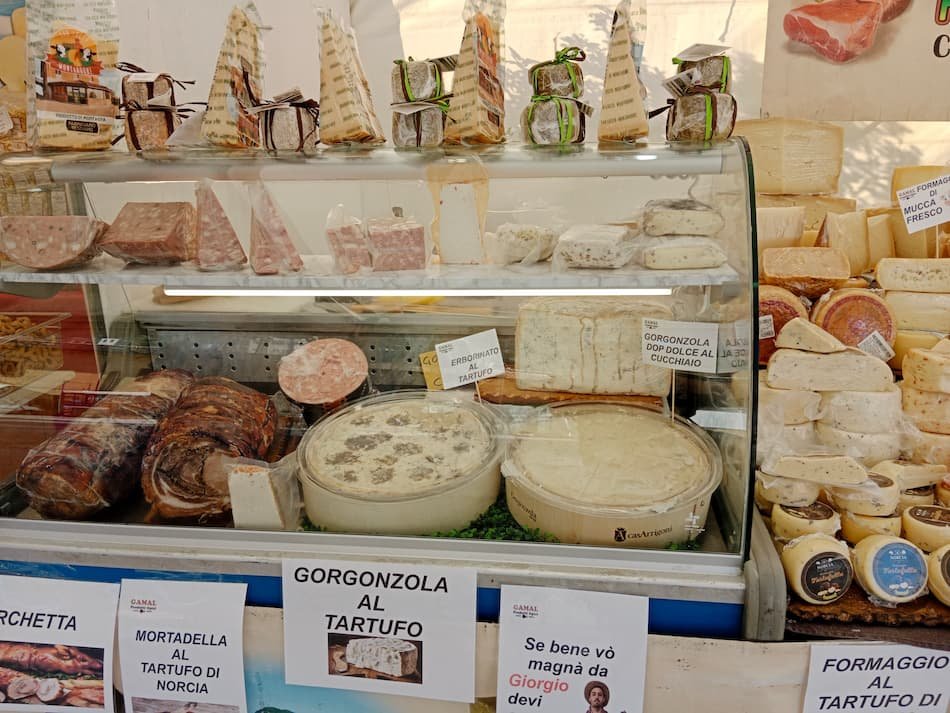
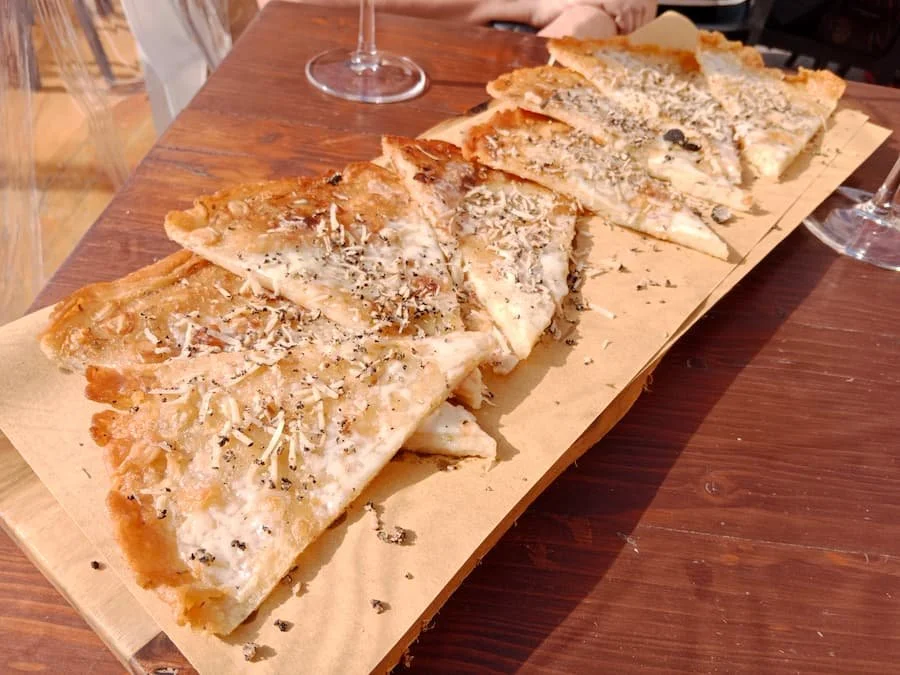
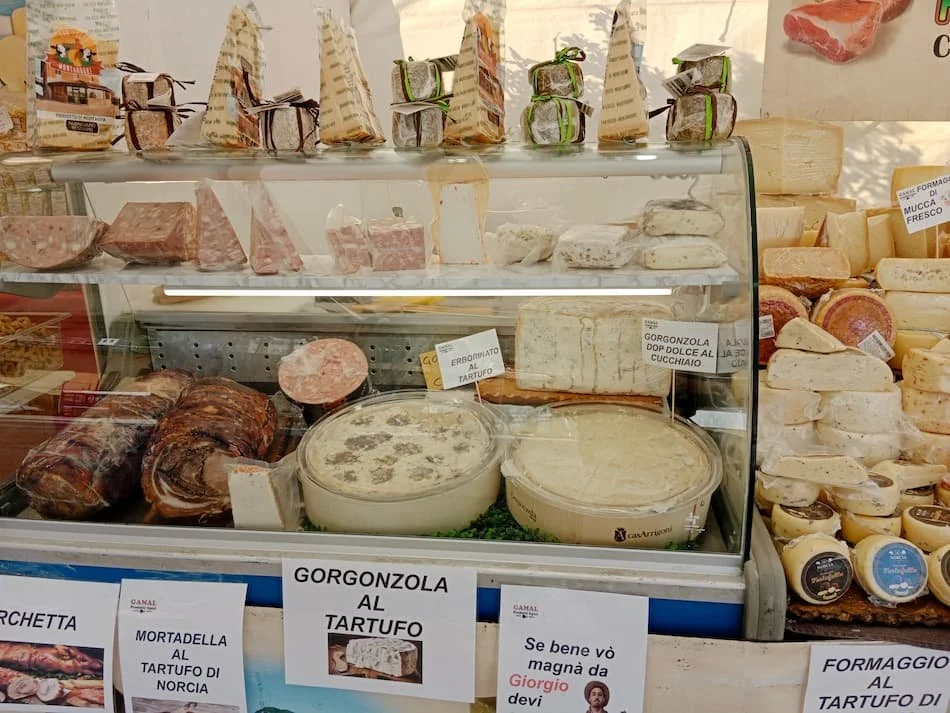
Mortadella with truffle. Gorgonzola with truffle. Truffled cheese. These people have their priorities straight.
Sensing a cheese plate in our immediate future, we loaded up on porchetta and a small variety of local cheeses, quelling my travel companion’s common-sense guilt by telling ourselves (lying to ourselves, let’s be honest) that we would gift some of our purchases. Allow me to spare you the anticipation: To date, no one in our circle of friends or relatives has received a single perishable from Gubbio. Part with my truffled brie? Not on your life.
But I digress… Back to the best restaurant in town.
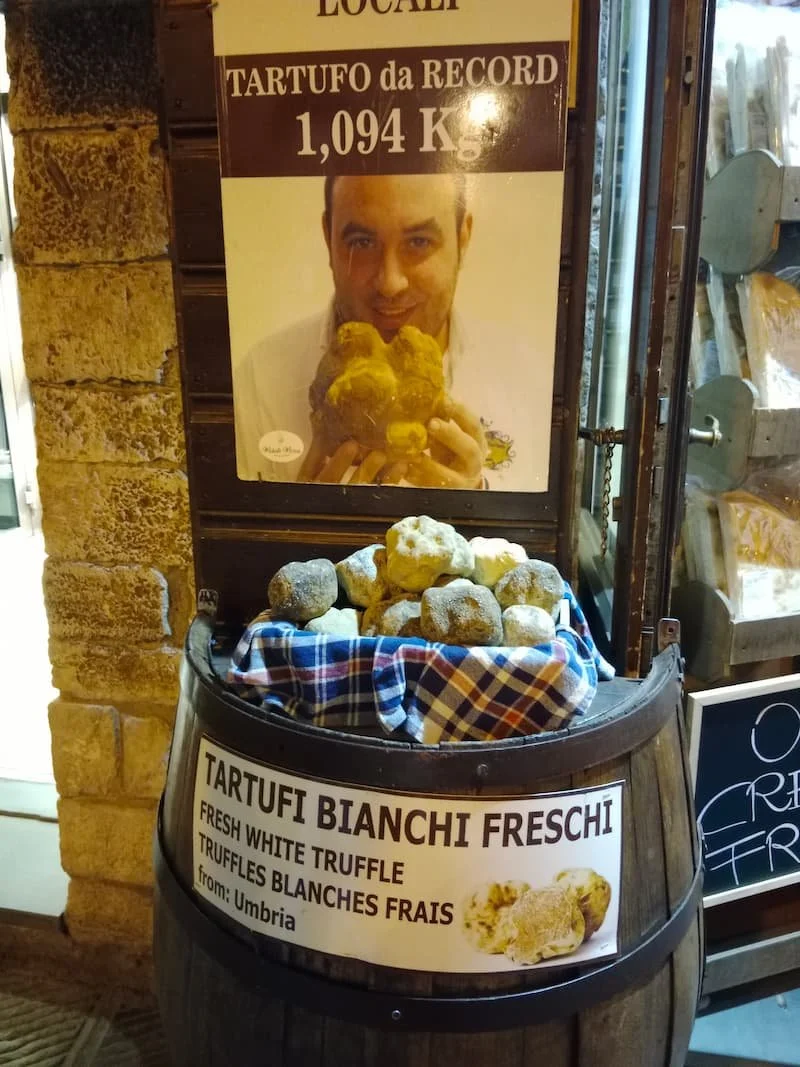
Truffles, also known as Tartufi in Italian, are used without abandon in Gubbio and one will find their aroma lingering daily in stores, streets, and restaurants. However, after trying several local haunts during our stay, Antica Osteria won us over.
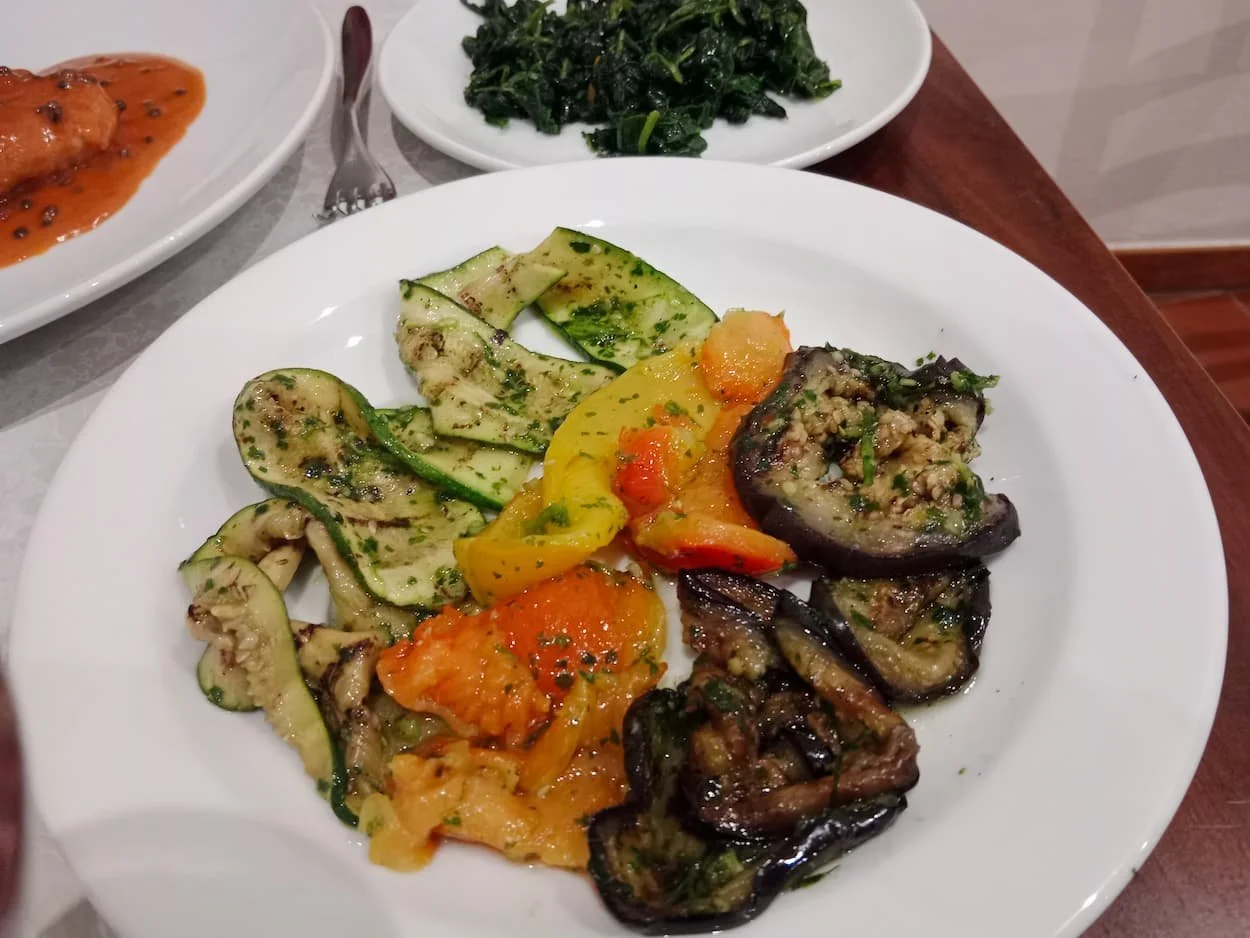
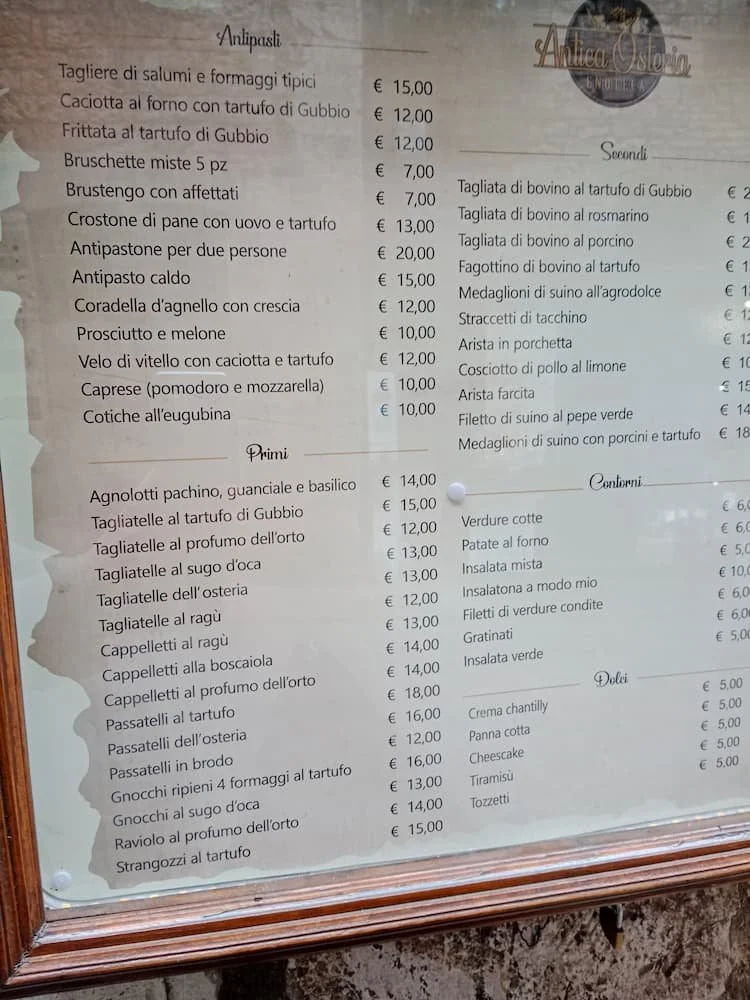
Just a few steps from our apartment, Antica Osteria serves up a no-nonsense menu of antipasti and main dishes, as well as a small selection of side plates and a dessert menu boasting some of my absolute favorites.
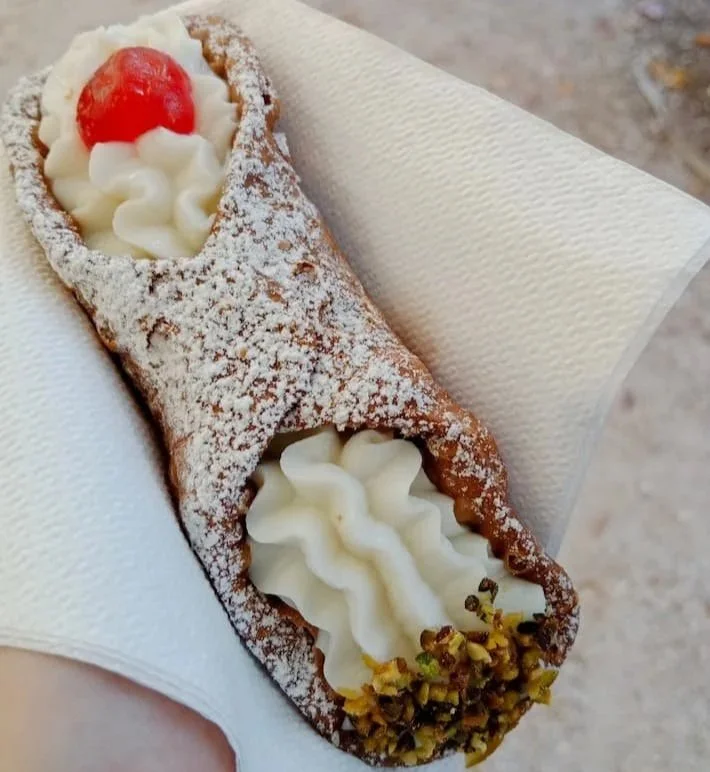
We also hunted down a stall selling cannoli because, let’s face it: No trip anywhere in Italy is complete without sampling a local cannolo.
Our server, a delightful local named Lori Dana, made the whole experience that much better with her honest suggestions, wine pairings, and friendly demeanor. While a busy neighborhood restaurant with a loyal following, locals and visitors from all over the region poured into the eatery in large groups during the Truffle Festival, regularly washing down 4- and 5-course meals with bottles of local red wine.
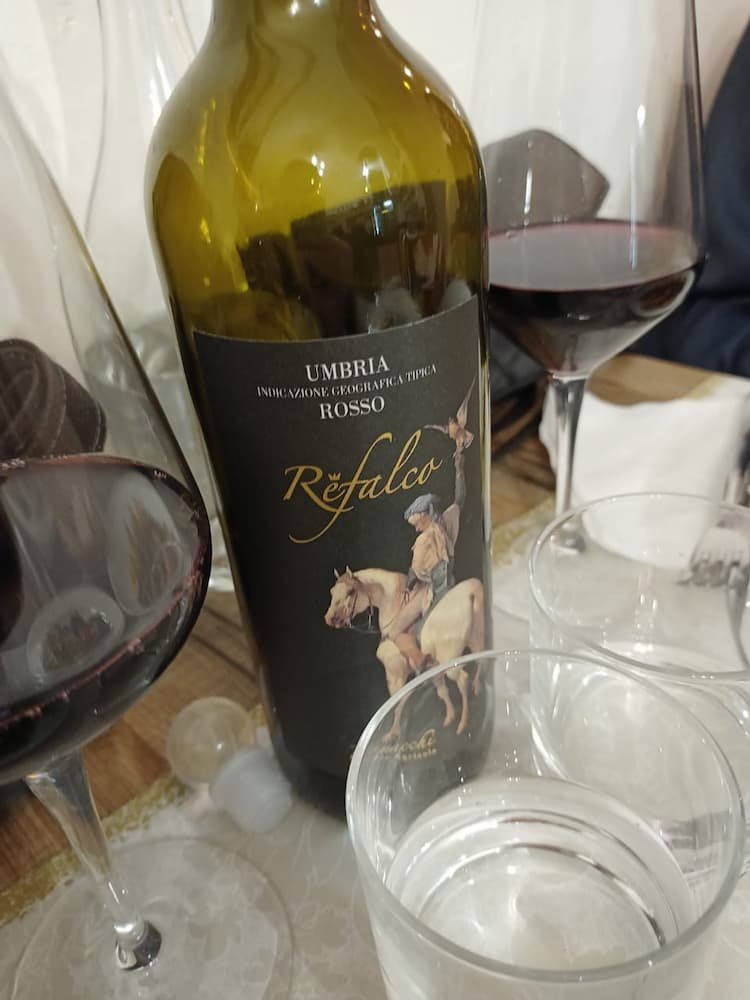
The vino of choice? An Umbrian Montefalco Rosso, a dryish medium-bodied red wine with hints of tomato leaves, charcoal, and earthy tannins. Not only did it pair beautifully with our meals, but the wine was able to stand up to the meaty flavor of the truffles shaved with great abandon onto our dishes.
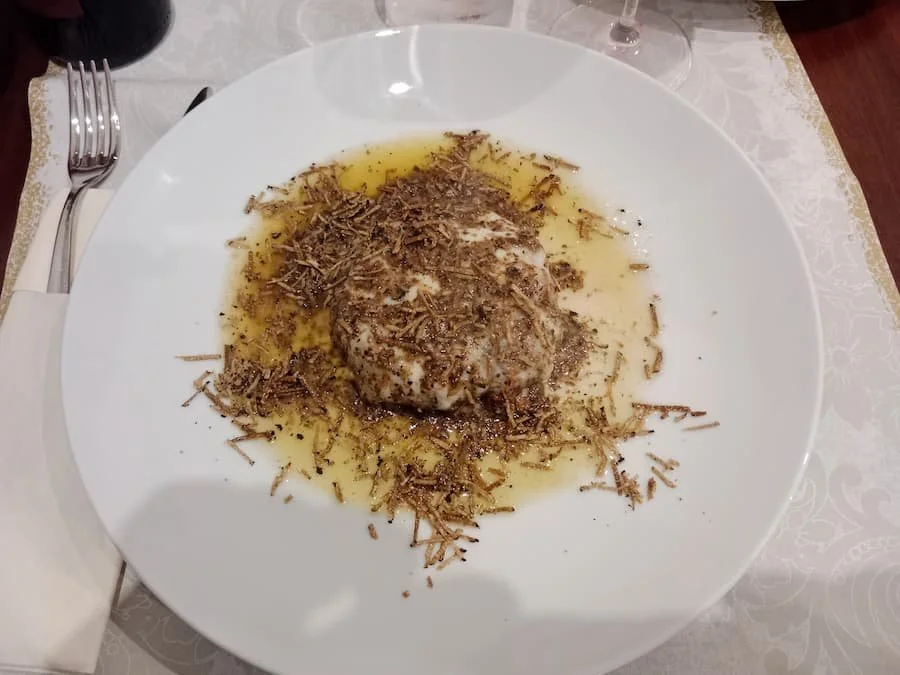
This truffle stuff is serious business here in Gubbio.
I know what you’re thinking: what could possibly top that? What else could these people possibly have up their sleeves?
Try the richest, silkiest crema chantilly on this side of Heaven. Now, I do not pretend to understand how something as rich yet humble as heavy cream can be whipped up into this kind of perfection. I’m not even sure I want to know; some things are better left unsaid. But this was nothing short of a revelation. Paired with a tiny glass of spiced port (a parting gift from Lori Dana), we had tears in our eyes when the check came—and not because they robbed us blind like the garden restaurant near the center.
No. This time it was a genuine sorrow.
Reluctantly, we left. The good news? We only had to walk 10 steps to arrive at our front door. The bad news? We still had 5 flights of stairs to climb. Oof! But climb them we did before falling into a heavy, dreamless sleep.
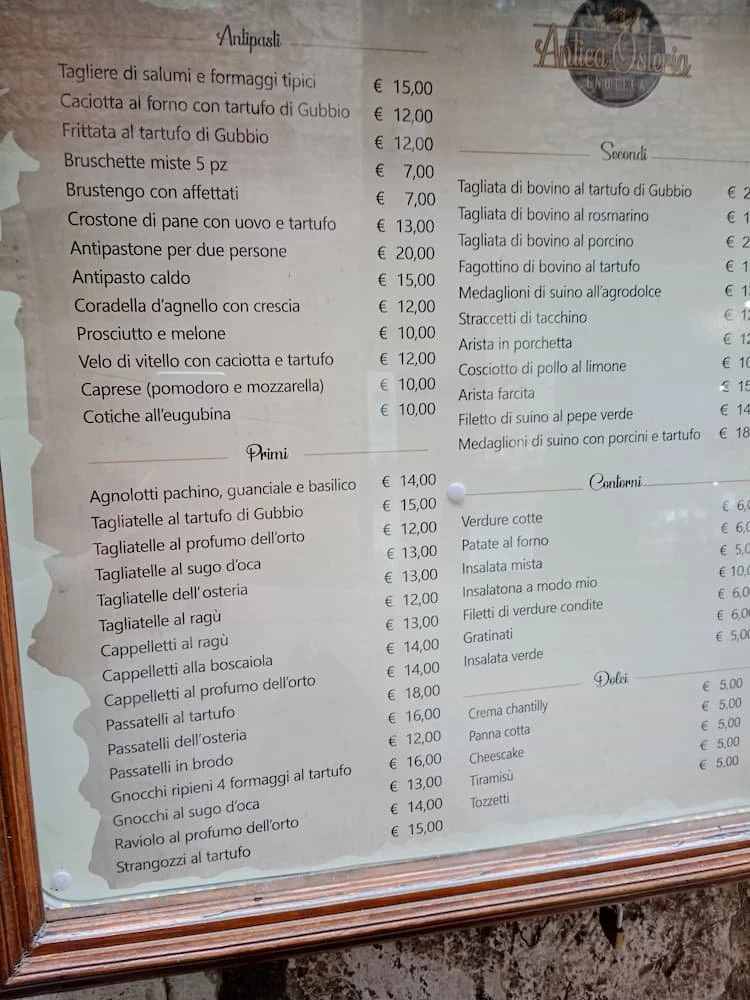
The menu at our favorite restaurant, Antica Osteria.
Gubbio, still fresh in my memory, is without a doubt one of the greatest surprises I’ve had for a long time. This authentic, elegant Umbrian town makes for a delightful day trip or a longer stay–particularly in fall when the leaves begin to change color, the air is fresh, and you don’t need to make excuses to show up for dinner early (it’s dark by 7 pm; what else do you expect me to do?!).
As I boarded my train for Venice, weighed down by an extra piece of luggage I had spontaneously accrued during my trip to Gubbio, I had already begun planning our next pilgrimage. After all, Silvia tells me there’s a port festival in spring that can’t be missed.
How can I argue with that?
Notes from the Field:
The church bell rings mostly (or seems to) at a quarter past the hour. But not every hour… Odd.
Yesterday, the main church bell rang 3 times, then 4, then 5, then once, then stopped. Although at 1 am, it only rang once!
Finally, I figured out the bell!!! 3:15 (Three loud gongs and 1 chime). 3:30 (Three loud gongs and 2 chimes). Gong = hour. Chime = 15-minute intervals. I am MIT material.
EARTHQUAKE!!! Nov 9, 2023. I awoke to my bed tossing me back and forth like an ice cube in a martini shaker! Had fallen asleep in my bathrobe—don’t want to die dressed in bathwear (even if it is made of cashmere).
Silvia told me that we are in the St. Martino neighborhood.
Friday, November 11 is Saint Martino Day. Another reason to love Italians—they have SO many Saints! We went out to celebrate with red wine and chestnuts in the square. Italian Saints have the best taste.
Gubbio is a lot of fun to pronounce for non-Italian speakers (my closest friend keeps leaving me voice memos beginning with GOO-bee-OH!). Probably about as fun as it is irritating for locals to hear foreigners exaggeratedly yelling the name of their city while pantomiming.
*These are from real notes I scribbled down during my 40-day stay.
No AI was used in writing any part of this blog. All material is the author’s sole intellectual property.